
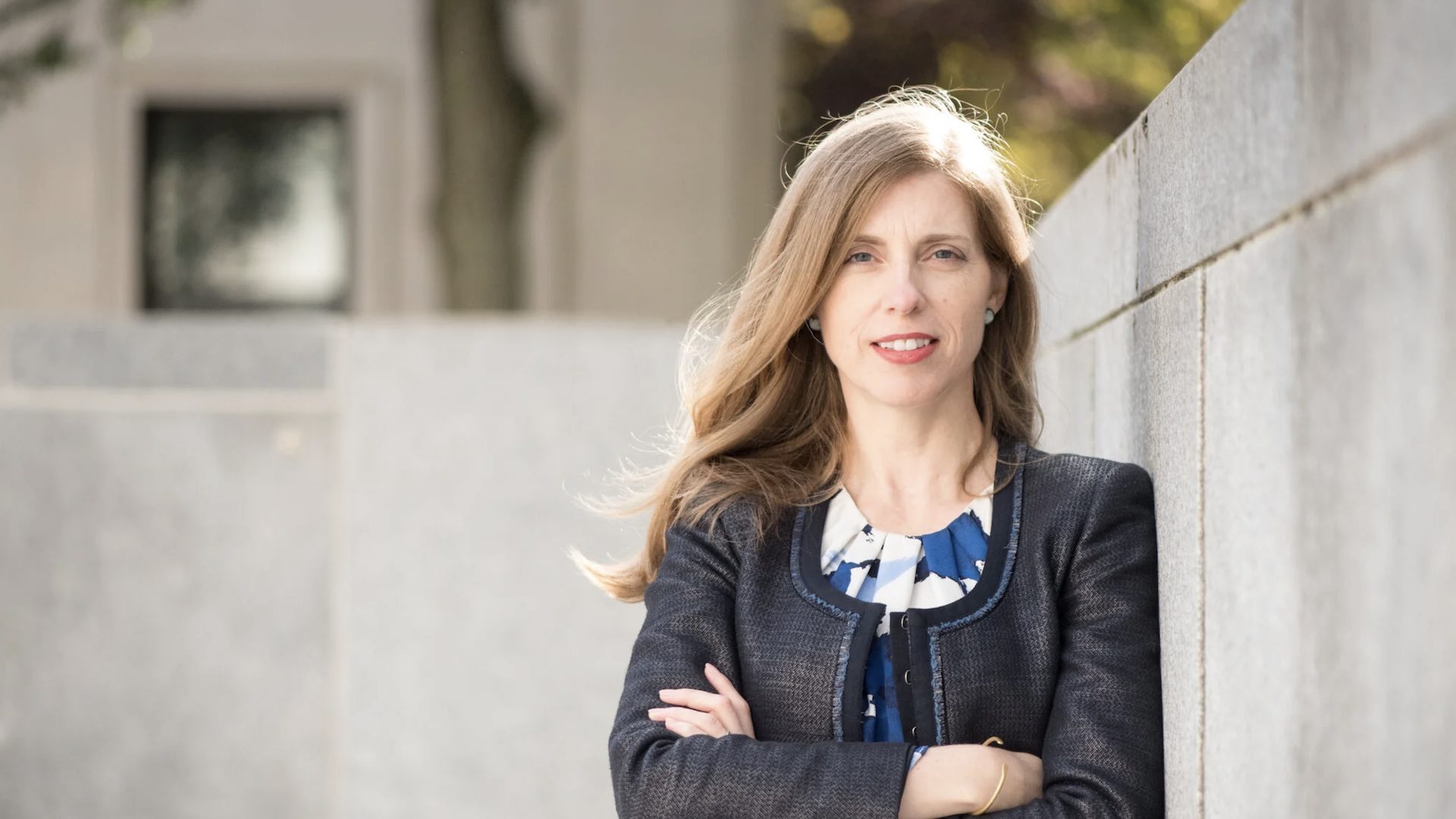
Just before the opening of the Athens Democracy Forum (September 30 – October 3) in Athens, Oikonomiki Epitheorisi spoke with Hélène Landemore, Professor of Political Science at Yale University and one of the most insightful analysts of contemporary democratic developments.
With the United States being tested by extreme political polarization, France shaken by social unrest, and the Western world searching for a new balance, Landemore offers her own explanation: modern democracies are being undermined by the arrogance of socio-political elites. As a response, she proposes a radical “lottocratic” model of governance, in which citizens are randomly selected to participate in decision-making and form more cohesive and representative governments.
At the same time, she avoids making predictions about the future of societies, describing the current instability as a precursor to a “post-democratic” era—a period during which democratic values are being “reconfigured” and China is claiming a leading role on the global stage.
Interview by Thanasis Katsikidis
(Published in Economic Review - September 2025)
Democracy, the People, and the Elites
Professor Landemore, Europe and the United States are experiencing a prolonged period of democratic turbulence. From Donald Trump’s administration to institutional instability in France, the West appears to be facing the consequences of postwar politics. In your view, what are the main reasons why democracies around the world seem increasingly fragile today?
My hypothesis is that the apparent vulnerability of democracies stems from one fundamental factor: they were not democratic enough in the first place. As a result, they fail to harness the resources of citizens’ collective wisdom and common sense.
Consider globalization, which today is often accused of destroying Western working classes for the benefit of Chinese workers, generating enormous economic inequalities within countries, and generally weakening national political sovereignty. All of this has, in turn, fueled the populist backlash and the authoritarian and nationalist tendencies we face today.
Yet rapid globalization was not a “natural” disaster or an external shock. It was the result of a series of decisions made by socio-economic elites who did not truly listen to the warning signals coming from ordinary citizens. There were moments when the public attempted to slow these decisions down, for example through the negative referendums on the Maastricht Treaty in France and the Netherlands in 2005.
It is difficult to fully understand the meaning of those negative votes, but one interpretation is that people did not necessarily want less globalization; they wanted a slower, more cautious, more inclusive, and more democratically managed version of it. Yet the system simply ignored them and continued with the neoliberal, bureaucratic agenda set in Brussels.
I fear the same problem is occurring now with the development of new technologies such as artificial intelligence. Where is the democratic input of citizens in all of this? And where are the brakes?
I should note that the oligarchic and plutocratic bias of existing democracies was masked during the “Glorious Thirty Years” (1945–1975) by a very particular postwar context. First, economic inequalities declined significantly; second, economic growth appeared to benefit everyone; and third, globalization had not yet begun undermining political sovereignty.
This is the era the MAGA (“Make America Great Again”) movement dreams about—a golden age of electoral democracy. But I believe that is an illusion. There is no going back to that “golden age,” which, incidentally, was not so golden for women and minorities.
On the other hand, I believe the only path is forward. This will require deepening the democratic characteristics of our institutions and exercising some imagination regarding how we can tame, reform, and even transform their plutocratic and oligarchic elements in order to navigate these uncertain waters with greater wisdom and resilience.
In your book Open Democracy, you describe a new model of democracy that empowers ordinary citizens and promotes social inclusion. Why is it superior to “electoral democracy”?
I believe my model is superior to electoral democracy because it focuses on discussions among ordinary citizens in all their diversity, rather than on the highly visible debates of a small circle of politicians cut from the same cloth—for example, lawyers in the United States, Oxford graduates in the United Kingdom, or graduates of the Grandes Écoles in France.
My model distributes power—especially the responsibility of representing others—among all citizens, not just socio-economic elites. As a result, it is more likely to tap into the collective wisdom of the broader public and produce better laws and policies than those advanced by current elected elites, with all their blind spots and conflicts of interest.
Trump and the Risk of Authoritarianism
In one of your lectures, you argued that electoral democracy tends to create elites disconnected from ordinary citizens. Could leaders such as Trump, paradoxically, represent a demand for more inclusive, bottom-up forms of politics?
Trump is the wrong answer to the right question, as many people have said before me. He is a symptom of popular frustration with the plutocratic and even corrupt aspects of today’s electoral democracy.
But he is not the democratic solution we need—which, to be honest, is not found on the left either. Trump is rather the classic populist authoritarian demagogue, embodying the backward-looking dream of a providential leader who will save the country from itself.
Trump is simply an opportunistic political entrepreneur who exploits popular anger for his own benefit. Should we blame the American people for falling into this trap? No, because I do not believe they have been offered a real choice for decades, if ever.
At least Trump represents a break with the status quo and sends a clear message that the system must be reformed before it transforms into something truly frightening.
If a lottery-based system were implemented, do you not foresee that old-fashioned fears and authoritarian ideologies might prevail within lottery-selected bodies and, consequently, within political power?
Nothing in the evidence we have—from more than 800 examples of small-group citizen deliberations conducted around the world—suggests that this fear of authoritarian outcomes is justified in the slightest.
The outcomes of these deliberations are sometimes progressive, sometimes conservative, with a tendency to identify new forms of consensus that include minorities.
I assume you are concerned about the use of lottery-based institutions in socially conservative countries such as Saudi Arabia or Afghanistan. It is true that deliberative outcomes in such contexts, on issues like LGBTQ rights or abortion, would probably not align with what we call liberal values.
Nevertheless, such deliberations may contribute to a more nuanced and tolerant understanding of these issues, if only because all participants have an equal voice.
Lottery-based collective processes cannot radically change a community’s values, at least not immediately. Only coercive force can do that, and even that rarely produces lasting results.
However, these citizen assemblies are an antidote to polarization, majority tyranny, and the impulsive, emotional, judgmental thinking that fuels intolerance. Therefore, no, I do not believe this fear is justified.
Participation, Disinformation, and Trust
Given declining civic participation, how can citizens remain willing to engage meaningfully in open democratic mechanisms? Is the electoral system itself alienating them?
You would be surprised by how grateful people are when they are given a voice and how willing they are to give democratic experiments such as citizens’ assemblies the benefit of the doubt.
But these processes must be organized in a way that is transparent, accountable, and respectful of both people’s time and intelligence.
Respecting their time means compensating them for participation and ensuring that their involvement has an impact. Respecting their intelligence means providing them with as much information as possible and entrusting them with as much responsibility as possible in the process.
I think elections today often feel both like a waste of time—because your vote seems to make no difference—and an insult to our intelligence, given the volume of lies, bad faith, and manipulation involved.
The war in Ukraine and the accompanying battle of propaganda and disinformation have exposed weaknesses in Western democratic systems. Does Putin’s ability—and that of other authoritarian leaders—to undermine Western democracies point to structural weaknesses within electoral democracy itself?
Democracies are only as resilient against disinformation as the trust their citizens place in them.
Therefore, I do not think Putin and other authoritarian leaders could inflict as much damage as they do if that trust had not already been eroded.
Consider Taiwan, where Russian and Chinese bots failed spectacularly to influence elections. As Audrey Tang explains, this is because citizens trust their government and are “vaccinated” even against sophisticated deepfakes thanks to public campaigns that educate people about disinformation tactics and proactively counter false videos and misleading social-media content before they spread.
Moral Leadership and Technology
Speaking of Trump, how do you see the “America First” policy affecting global democratic norms? Does it accelerate the departure from democratic values?
One could argue that America First represents a return to domestic sovereignty and therefore contains democratic potential. It returns power to voters at the national level.
I think some degree of deglobalization in this sense is probably positive. As I said earlier, governments likely moved too fast without truly checking whether their populations were comfortable with the consequences.
Brexit and America First are partly reactions to the perceived loss of national sovereignty and attempts to reclaim it.
The problem is that prioritizing America is being done in a way that undermines democratic norms globally—namely the idea that we are all human beings and equally deserving of protection.
Historically, America has championed a range of liberal and democratic values that had—and still have—a universal orientation and appeal. By retreating behind its borders and disclaiming responsibility for the fate of other populations around the world, the United States is effectively abandoning this position of moral leadership and adopting a more isolationist and inward-looking posture that benefits authoritarian leaders worldwide.
It also pits countries against one another in a global game presented as purely zero-sum: when other countries win, America loses.
I believe there is a democratic way for the United States to pursue its national interests while simultaneously advancing the interests of other countries.
Trump and Putin aside, what role do globalization and digital technologies such as artificial intelligence play in weakening, transforming, or strengthening democracy today?
Again, I believe the problem is not globalization and digital technologies themselves, but the power structures that shape these phenomena and give them direction.
The globalization we experienced was shaped by powerful actors who did not necessarily reflect the preferences and interests of national majorities.
Similarly, digital technologies and artificial intelligence are deployed according to what maximizes shareholder value, rather than what democratically defined local or global public interests require.
Ultimately, it is all about power—and who exercises it.
From Democracy to Post-Democracy?
Can democracy be repaired and revitalized, or are we entering a post-democratic era?
I do not like making predictions, but if I had to place a bet, I would say that we are entering a post-democratic era.
China’s emergence as a superpower and political model for many, the simultaneous rise of “executive monarchy” thinkers such as Curtis Yarvin, and the enormous sums being invested in artificial intelligence compared with the meager resources devoted to democratic innovations—all of these signs point in the same, unfortunate direction.
I believe we must resist the direction of history.
I see myself as trying to preserve the possibility of a return to democratic values in a few years—or perhaps a few decades, who knows—when the anti-democratic and illiberal turn proves mistaken.
If it is not too late by then, I hope that the work being done by myself and others to establish the value of citizen-centered institutions can be mobilized to deepen and renew democracy.
But at the moment, all I see are dark clouds.
In conclusion, what form of democracy is compatible with the current state of global affairs?
For me, local democracy, state-level democracy, online democracy, and the education of younger generations are the key battlegrounds.
If we can persuade ordinary people to cultivate democratic values and continue exercising their democratic rights at multiple levels—below the radar, so to speak—we can hope to weather the storm and prepare for the next phase.
(Photo credits: HeleneLandemore.com)