
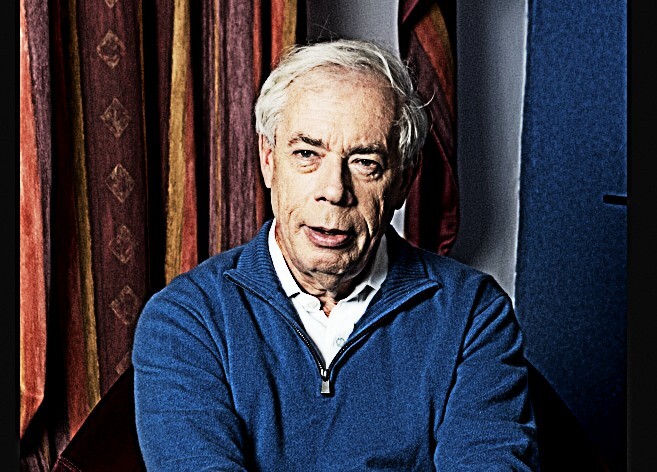
“What we define today as ‘modern corporations’ are essentially collections of human capabilities, and it is a mistake to think of them as equivalent to factories, as was the case during the Industrial Revolution.” With this observation, our conversation with one of Britain’s leading economists, Sir John Kay, begins. Speaking to Oikonomiki Epitheorisi, Sir John—Fellow of the British Academy, founding dean of the University of Oxford’s Saïd Business School, and professor at both the London School of Economics and London Business School—emphasizes that the industrial production line has now been transformed, with people at its center.
As he explains in the interview, the modern corporation should be viewed as a collection of capabilities and business assets, where ownership of physical infrastructure matters less than the ability to combine skills to solve complex challenges. In this extensive interview, Sir John also expresses caution about the future, arguing that one of the most difficult puzzles of our time remains how the global order will evolve in the “post-Trump” era.
Interview by Thanasis Katsikidis
(Published in Economic Review - December 2025)
The Corporation of the 21st Century
Sir John, in your recent book The Corporation in the 21st Century, I was struck by your argument that “ownership of the means of production is a redundant concept” and that employees “take the factory home with them.” Decoding the central points of your argument, how have capitalism and its means of production been transformed in the 21st century?
The means of production have changed dramatically from the physical assets—such as production lines—that characterized the early stages of the Industrial Revolution, when much of the economy was based on manufactured goods such as automobiles. Today, the means of production are in the hands of the people who work in companies, and this is especially true of modern businesses. The process is obvious and is essentially what Apple is all about, taking place through design and coding activities.
To the surprise of many people, this is also true across a wide range of other activities. Amazon, for example, is another archetypal 21st-century company. Amazon does not own the warehouses—or at least most of the warehouses—from which its products are distributed. It does not own the vehicles that deliver them. The essence of Amazon lies in its technology and its people. And this is characteristic of modern companies: the means of production are people.
What characteristics define modern corporate structures and employment relationships today?
What we define as “modern corporations” today are something like collections of capabilities—as in the cases of Apple and Amazon—and it is a mistake to think of them as equivalent to factories, as people did during the Industrial Revolution.
I therefore believe it is better to view the modern corporation as a set of capabilities and business resources, as to some extent it always has been, focusing on understanding the skills required to solve specific industrial challenges and on how those capabilities can be combined. That is precisely what 21st-century companies do.
Competition and Scale
Economists often stress the importance of competition. Yet many of the world’s largest companies, such as Amazon, Apple, and Google, dominate their markets, creating what appear to be monopolies. What does this suggest about how capitalism functions today compared with how it is taught in universities?
They dominate their markets because we define those markets too narrowly. Let us take the three examples you mentioned. Apple, for instance, was a pioneer in smartphones, but nobody seriously believes it has a monopoly on smartphones. What Apple has a monopoly on is a particular set of capabilities that distinguishes it, such as its outstanding design and the premium pricing that results from it. But there is no monopoly.
Likewise, Amazon does not have a monopoly in the sense that there is no monopoly in online retailing. Google’s case, however, is more interesting. When Google first entered the market, I assumed that other companies would develop search engines tailored to particular categories of users. Someone like me, for example, might use academic search engines, while others interested in retail shopping would use different websites, and so on.
It is therefore interesting that Google has largely succeeded in developing all these search capabilities itself. We shall see how long that lasts, because entry into this activity is not actually very difficult. We can already see how artificial intelligence is changing the nature of search.
You have argued that large companies and organizations endure because they possess a clear sense of purpose. Yet today we see many startups and new businesses replacing companies that were once dominant. Do you believe mainstream corporations are losing their sense of purpose, or do smaller, more agile firms simply have a better chance of succeeding in today’s environment?
I think both things are happening. Large, established corporations have indeed lost some of their focus. I have spoken extensively about companies such as ICI in Britain and Boeing in the United States, which were once large and dominant but have since lost part of their strength.
The Pace of Technological Change
In a recent lecture at the University of Oxford, you said that “we tend to overestimate the short-term impact of technological change and underestimate the long-term impact.” In the era of the AI revolution, where new artificial intelligence models claim they can predict everything from stock prices to pandemics, do you believe AI is the key to managing uncertainty, or does it simply give us a false sense of control?
No, I do not believe that. First of all, let me return to the point you raised. There are some very obvious similarities between the dot-com boom of 1999 and the AI boom today. As you suggested, people overestimate the short-term impact of these changes and fail to understand the long-term impact. That was very clear in the case of the internet’s effect on business.
If you read articles from 1999, everyone was saying that the internet would change everything. And indeed it did change everything, but over a much longer period than people expected. The other day I looked at the “Magnificent Seven” companies of 2000—the seven firms with the highest market capitalizations at the time. Of those seven, only one, Microsoft, remains large, successful, and important today. The other six have either disappeared or become shadows of their former selves.
It is difficult to believe now that in the early 2000s Cisco was the most valuable company in the world. Had you invested in it then, you would have lost money 25 years later. People greatly exaggerate short-term corporate outcomes but fail to understand long-term outcomes.
Now, to your second question: does artificial intelligence make us much better at predicting the future? I would be surprised if that were true, because the world is fundamentally uncertain. We do not know what will happen. People will try all sorts of new things, most of which will not work. That is the nature of a market economy as it evolves, and I think it will remain so.
If markets begin to rely on AI-driven models, do you expect that to stabilize markets or make them more vulnerable and ultimately prone to collapse?
There are two issues here. One is market vulnerability, which today is being created by the extraordinary valuations people assign to AI-related stocks. Once again, this mirrors the situation in 1999, when people assigned irrational valuations to internet-related stocks on the assumption that the dominant positions enjoyed by certain companies would last forever. That assumption was obviously false. I think the same applies today.
Markets on Planet Trump
To shift topics slightly, during Donald Trump’s presidency we have seen how the words of a single leader—through tweets, policy announcements, or trade decisions—can move entire markets within minutes. How vulnerable are today’s markets to psychological factors?
I do not think anything particularly unusual is happening. As I explained earlier, we have been through these periods of excessive booms and busts before. I was quite amused when I looked at the British railway boom of the 1840s, when people assigned outrageous values to railway stocks because they correctly believed that railways would transform almost everything in the economy over the long term. Yet once again, they did not transform everything overnight.
I was especially entertained by the correspondence of the Brontë sisters, who invested in railway shares during the 1840s and lost most of their money, just as many investors will do again in future booms. Markets have gone through these cycles of exuberance and collapse many times. Excessive faith is simply not sustainable over many years or decades.
How can societies and businesses adapt to an era of institutional uncertainty? And do businesses have the right tools to cope with the uncertainty we face today?
No, they do not. This returns to a point you raised earlier: people exaggerate the extent to which we can develop econometric or economic models capable of predicting these developments and forecasting the future. As I explained in relation to the internet and artificial intelligence, people are actually very poor at understanding how these things will work out in the future.
The way market economies function is through experimentation. People try many different approaches. Many fail, while some succeed. You would not have bet in the 1970s or 1980s that Apple and Microsoft would become the winners of the information technology revolution—you would have bet on IBM. IBM was, for a decade, the most important company in the world. Those who bought IBM shares were right to believe that technology would transform the future, but the future did not end up being transformed primarily because of IBM.
Uncertainty and Experimentation
In your book Radical Uncertainty, you argue that we cannot model the future with precision. The unpredictable nature of today’s world—trade wars, political shifts, and geopolitical tensions—seems to put that thesis to the test. What have recent years taught us about how markets function and how businesses deal with uncertainty?
The most important thing I have learned—and it took me 20 to 30 years to fully appreciate it—is that the real power of markets lies in people who have the freedom to experiment.
Most of those experiments fail, but some succeed. That is how economies progress. This stands in complete contrast to what I call the “great man theory” of business history—the idea that certain individuals possess extraordinary intelligence and foresight, enabling them to predict the future, and that corporate success depends on finding such people.
I think that theory is complete nonsense. We would still have achieved mobile phones and modern computing even if Steve Jobs and Bill Gates had never been born.
Speaking of forecasts and predictions, what are the most important challenges humanity may face over the next five to ten years—challenges for which we may not yet be prepared?
I think we do not fully understand that what we once regarded as the Left-Right political structure was fundamentally destroyed by the collapse of communism in the 1980s. The political system based on the polarization between workers and capitalists no longer has much to contribute, for the reasons I described regarding the changing nature of corporations and economic divisions.
Figures such as Trump in the United States, Nigel Farage in the United Kingdom, Marine Le Pen in France, and the AfD in Germany attract an angry, dissatisfied, and resentful working class that once formed the base of left-wing parties. The reality is that politics will never be the same again, and the question is what it will look like in the post-Trump era.
And making any prediction about such a major issue is, for me, extraordinarily difficult.